
When working with electrical cables in global projects, you will often encounter two different conductor sizing systems: AWG (American Wire Gauge) and square millimeters (mm²). Understanding AWG to mm² conversion is essential for engineers, electricians, cable manufacturers, and international traders.
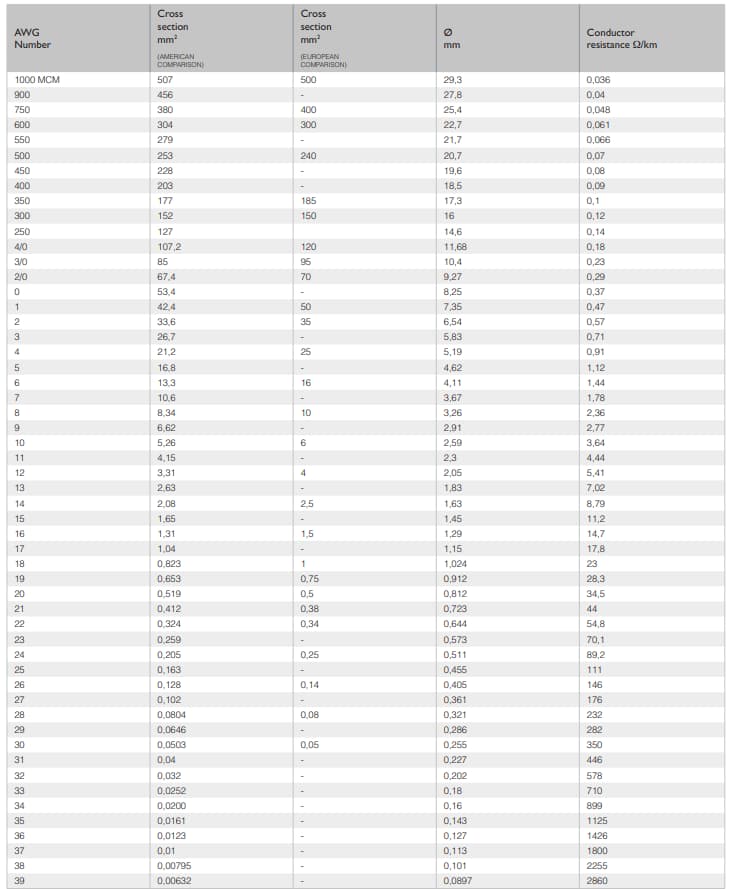
AWG is a standardized wire gauge system primarily used in the United States and Canada. In this system, the gauge number is inversely proportional to the conductor size. That means the smaller the AWG number, the larger the wire diameter. For example, 4 AWG is much thicker than 14 AWG. As the wire becomes thicker, its current-carrying capacity (ampacity) increases, and its electrical resistance decreases.
On the other hand, mm² is a metric measurement that directly represents the conductor’s cross-sectional area. It is widely used in Europe, Asia, and most international IEC-based standards. Unlike AWG, mm² increases directly with conductor size, making it more intuitive in many engineering calculations.
Because the two systems are based on different calculation principles, AWG to mm² conversion is not linear. The AWG system follows a logarithmic scale. For example:
- 14 AWG ≈ 2.08 mm²
- 12 AWG ≈ 3.31 mm²
- 10 AWG ≈ 5.26 mm²
- 4 AWG ≈ 21.15 mm²
- 1/0 AWG ≈ 53.5 mm²
Accurate conversion is critical when specifying cables for international projects, importing/exporting electrical products, or comparing IEC and ASTM standards. Using the wrong conductor size can lead to overheating, voltage drop issues, or compliance problems.
In summary, AWG to mm² conversion bridges the gap between American and metric systems. By understanding both standards, professionals can ensure proper cable selection, electrical safety, and global compatibility in power and industrial applications.
Please contact us for cable inquiry.