
In electrical engineering, choosing the correct conductor size is essential. However, different regions use different measurement systems. About AWG to mm², In North America, professionals use AWG (American Wire Gauge). In contrast, most international markets rely on square millimeters (mm²).
As a result, engineers, electricians, and buyers often need a reliable way to convert between these two systems. Therefore, understanding AWG to mm² conversion becomes critical for accurate cable selection.
Here, DOS Cable will show how the AWG system works, why conversion matters, and how to use a complete reference table effectively.
What Does AWG Mean?
AWG stands for American Wire Gauge. It defines the diameter of electrical conductors using a standardized numerical system.
Unlike metric measurements, AWG follows a reverse scale. In other words:
- Smaller numbers indicate thicker wires
- Larger numbers indicate thinner wires
For example, 4/0 AWG has a much larger diameter than 1 AWG. Similarly, 12 AWG is thicker than 20 AWG.
Because of this unique structure, many users find AWG confusing at first. However, once you understand the pattern, it becomes easier to compare wire sizes.
Why You Need AWG to mm² Conversion
In global projects, you cannot rely on a single standard. Instead, you must switch between AWG and mm² depending on the region. For this reason, conversion plays a key role in several areas.
1. International Projects
First, different countries follow different standards. While the U.S. uses AWG, most other regions use mm². Therefore, conversion ensures that specifications match across markets.
2. Current Capacity Comparison
Next, the conductor area directly affects current-carrying capacity. When you convert AWG to mm², you can easily compare ampacity using IEC standards.
3. Electrical Design
In addition, most engineering calculations require metric units. As a result, designers must convert AWG values into mm² before performing calculations.
4. Procurement and Sourcing
Finally, buyers often compare products from different suppliers. By using a conversion table, they can quickly identify equivalent cable sizes.
AWG to mm² Conversion Table
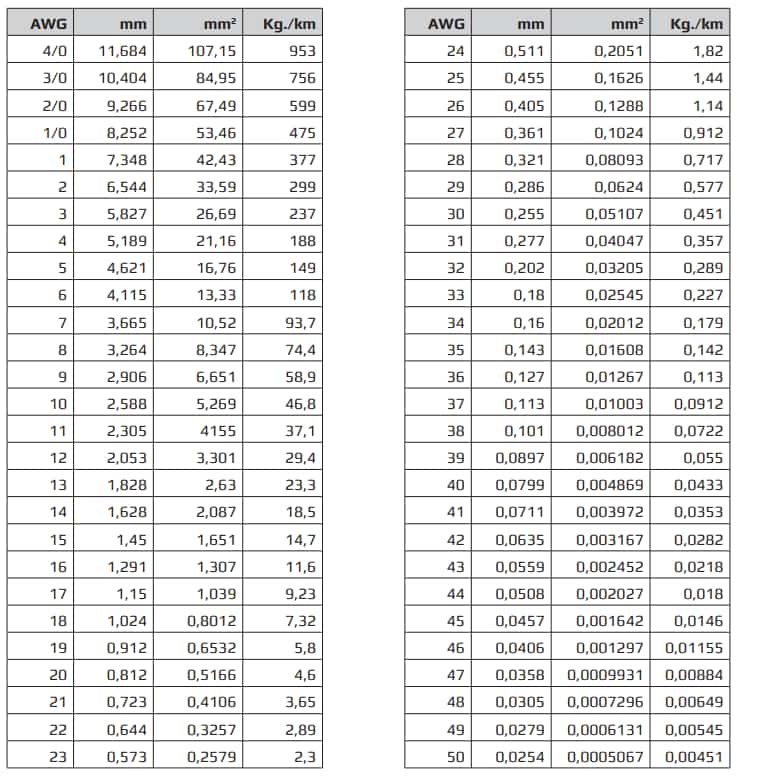
Below is a practical reference table showing conductor diameter, cross-sectional area, and approximate copper weight:
| AWG | Diameter (mm) | Area (mm²) | Weight (kg/km) |
|---|---|---|---|
| 4/0 | 11.684 | 107.15 | 953 |
| 3/0 | 10.404 | 84.95 | 756 |
| 2/0 | 9.266 | 67.49 | 599 |
| 1/0 | 8.252 | 53.46 | 475 |
| 1 | 7.348 | 42.43 | 377 |
| 2 | 6.544 | 33.59 | 299 |
| 3 | 5.827 | 26.69 | 237 |
| 4 | 5.189 | 21.16 | 188 |
| 5 | 4.621 | 16.76 | 149 |
| 6 | 4.115 | 13.33 | 118 |
| 7 | 3.665 | 10.52 | 93.7 |
| 8 | 3.264 | 8.347 | 74.4 |
| 9 | 2.906 | 6.651 | 58.9 |
| 10 | 2.588 | 5.269 | 46.8 |
| 11 | 2.305 | 4.155 | 37.1 |
| 12 | 2.053 | 3.301 | 29.4 |
| 13 | 1.828 | 2.63 | 23.3 |
| 14 | 1.628 | 2.087 | 18.5 |
| 15 | 1.45 | 1.651 | 14.7 |
| 16 | 1.291 | 1.307 | 11.6 |
| 17 | 1.15 | 1.039 | 9.23 |
| 18 | 1.024 | 0.8012 | 7.32 |
| 19 | 0.912 | 0.6532 | 5.8 |
| 20 | 0.812 | 0.5166 | 4.6 |
| 21 | 0.723 | 0.4106 | 3.65 |
| 22 | 0.644 | 0.3257 | 2.89 |
| 23 | 0.573 | 0.2579 | 2.3 |
| 24 | 0.511 | 0.2051 | 1.82 |
| 25 | 0.455 | 0.1626 | 1.44 |
| 26 | 0.405 | 0.1288 | 1.14 |
| 27 | 0.361 | 0.1024 | 0.912 |
| 28 | 0.321 | 0.08093 | 0.717 |
| 29 | 0.286 | 0.0624 | 0.577 |
| 30 | 0.255 | 0.05107 | 0.451 |
| 31 | 0.227 | 0.04047 | 0.357 |
| 32 | 0.202 | 0.03205 | 0.289 |
| 33 | 0.180 | 0.02545 | 0.227 |
| 34 | 0.160 | 0.02012 | 0.179 |
| 35 | 0.143 | 0.01608 | 0.142 |
| 36 | 0.127 | 0.01267 | 0.113 |
Common Wire Size Equivalents
To simplify selection, you can remember a few key conversions. For instance:
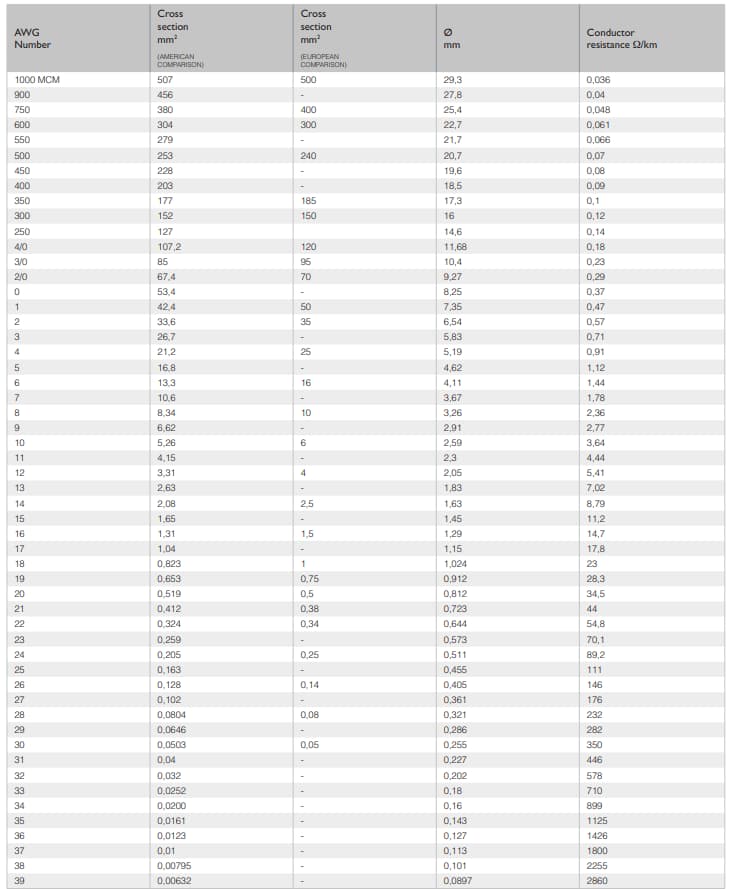
- 12 AWG equals approximately 3.31 mm²
- 10 AWG equals about 5.26 mm²
- 8 AWG corresponds to roughly 8.37 mm²
- 6 AWG converts to 13.3 mm²
These sizes appear frequently in real applications. For example, they are widely used in building wiring, solar systems, and industrial installations.
How Conversion Works
You can calculate the conductor area using a basic formula:A=4π×d2
Here, d represents the conductor diameter in millimeters.
However, AWG follows a logarithmic progression. Therefore, manual calculation is not always practical. Instead, most professionals rely on standard tables for faster and more accurate results.
AWG and mm²: Key Differences
Although both systems measure conductor size, they serve different regions. On one hand, AWG dominates in North America. On the other hand, mm² remains the global standard.
Because of this, international projects often require both systems. Consequently, understanding their relationship helps prevent specification errors.
Conclusion
Accurate wire sizing directly affects safety and performance. Therefore, mastering AWG to mm² conversion is essential for engineers, manufacturers, and buyers.
By using a reliable conversion table, you can:
- Select the correct cable size
- Compare global standards efficiently
- Ensure proper current capacity
- Improve purchasing decisions
In the end, a simple conversion chart can save time, reduce errors, and improve project outcomes.