
1. Einführung
Submarine power cables rated at 132kV/138kV/145kV/230kV Unterseekabel represent a critical class of high‑reliability transmission products used for offshore wind farms, inter‑array and export connections, cross‑sea interconnections, island power supply, and coastal grid reinforcement projects. These voltage levels are widely adopted because they offer an optimal balance between transmission capacity, electrical losses, installation feasibility, and long‑term operational stability.
From a cable manufacturer’s perspective, the competitiveness of a submarine cable is not defined solely by voltage rating. Instead, it is determined by product structure, Materialauswahl, and especially the performance of the Bleischeide, which plays a decisive role in water blocking, electrical integrity, and mechanical robustness under harsh subsea conditions.
This article provides an in‑depth technical overview of 132kV/138kV/145kV/230kV submarine cable structures, with a strong focus on the lead sheath design, manufacturing considerations, and conductor options ranging from 50 mm² bis 2500 mm², in full compliance with IEC conductor standards for both copper and aluminum.
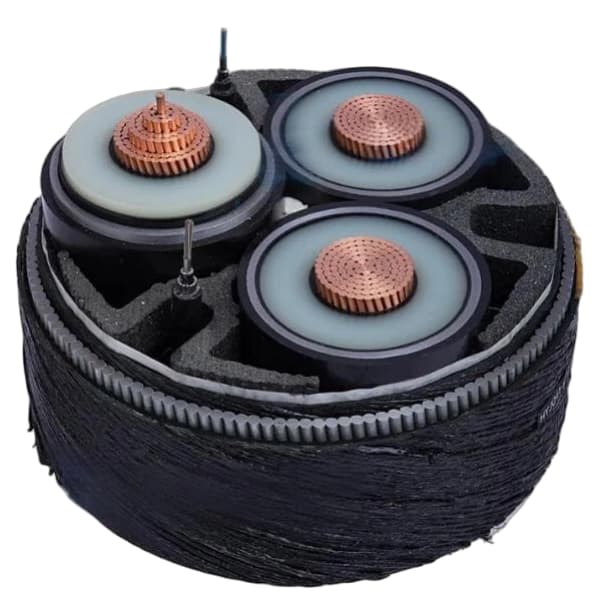
2. Typical Applications of 132kV/138kV/145kV/230kV Submarine Cable
High‑voltage submarine cables in this range are commonly used in the following applications:
- Exportkabel für Offshore-Windparks (from offshore substation to onshore grid)
- Inter‑array and collector systems for large offshore renewable projects
- Cross‑sea and cross‑river transmission links
- Power supply for islands, Offshore-Plattformen, and coastal industrial zones
- Grid reinforcement between coastal substations
These applications impose strict requirements on electrical performance, mechanische Stärke, Korrosionsbeständigkeit, and long‑term water tightness—requirements that directly influence cable structure design.
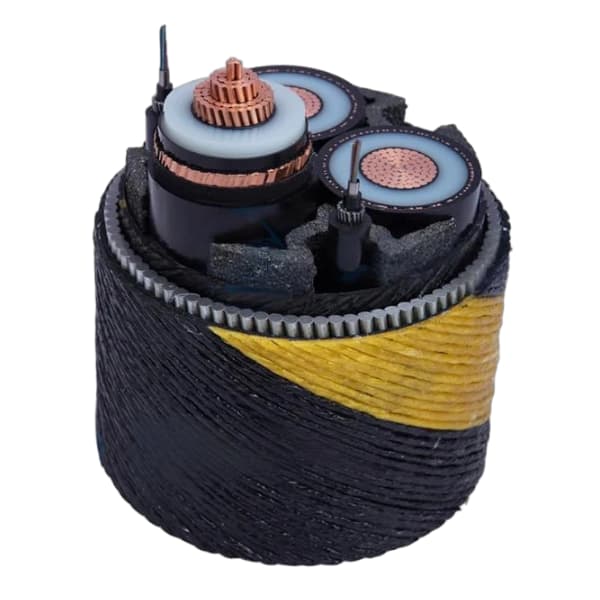
3. Overall Product Structure of High‑Voltage Submarine Cables
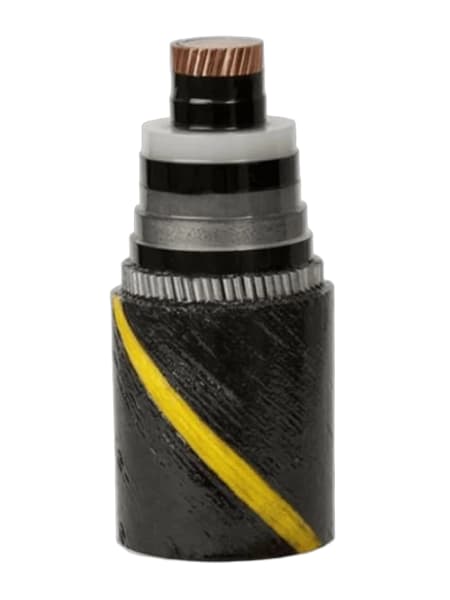
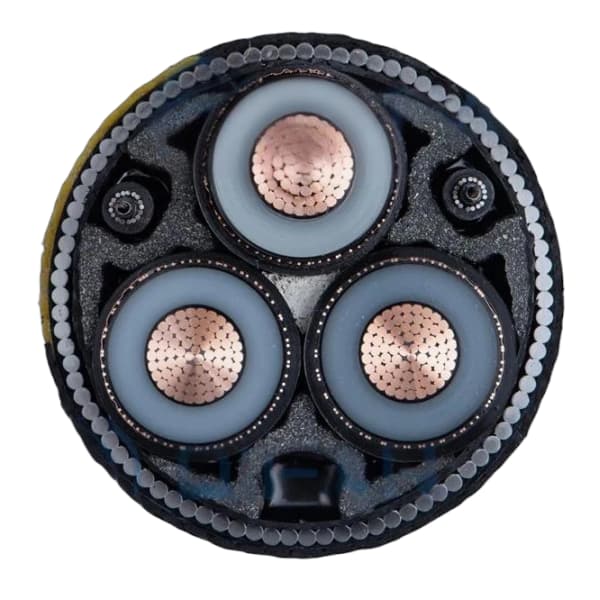
A 132kV/138kV/145kV/230kV submarine cable typically adopts a single‑core XLPE insulated structure with heavy metallic sheathing and external armoring. From the center outward, the standard structure includes:
- Dirigent (Copper or Aluminum)
- Conductor screen
- XLPE-Isolierung
- Insulation screen
- Metallschirm (copper wires or tape)
- Bleischeide (critical component)
- Bettungsschicht
- Panzerung (single or double layer steel wire)
- Outer serving / Außenmantel
Among these layers, Die Bleischeide is considered the most important structural element for submarine applications.
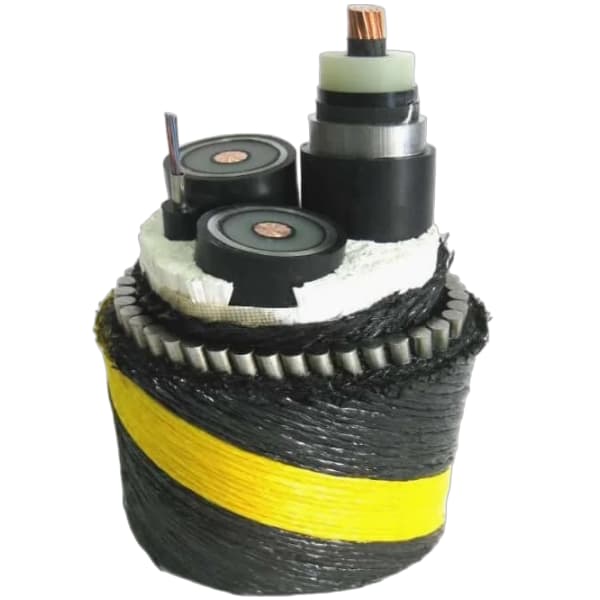
4. Conductor Design and IEC Standardization
4.1 Conductor Materials
Submarine cables in the 132kV–230kV range typically use:
- Kupferleiter: Höhere Leitfähigkeit, compact size, higher cost
- Aluminiumleiter: Geringeres Gewicht, cost‑effective, larger cross‑section for equivalent current
Both conductor types are fully standardized under IEC 60228, ensuring compatibility with international grid and project requirements.
4.2 Leiterkonstruktion
- Stranded, circular compacted conductors
- Milliken segmented conductors may be used for larger cross‑sections (≥1000 mm²) to reduce AC losses
- Longitudinal and radial water‑blocking measures applied at conductor level if required
5. XLPE Insulation System
For 132kV to 230kV submarine cables, dry‑cured XLPE insulation is the industry standard. Key technical characteristics include:
- Hervorragende Durchschlagsfestigkeit
- Low dielectric losses (low tan δ)
- Long service life under continuous electrical stress
- Compatibility with high operating temperatures (typically 90°C continuous, 105°C emergency)
The insulation thickness increases with voltage level and is carefully designed according to IEC 60840 and IEC 62067.
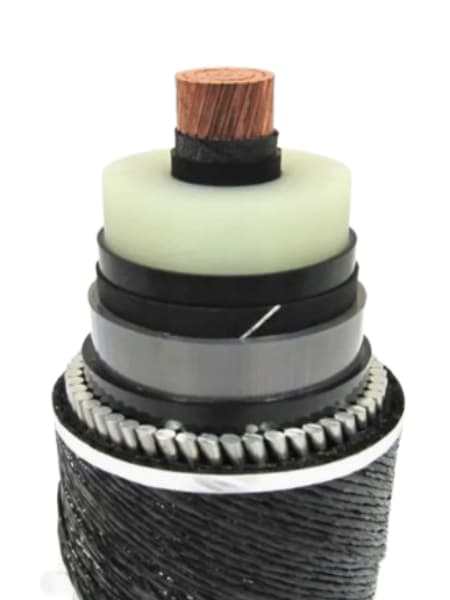
6. Lead Sheath – The Core of Submarine Cable Reliability
6.1 Why Lead Sheath Is Essential
In submarine environments, cables are permanently exposed to:
- High hydrostatic pressure
- Seawater corrosion
- Mechanical impacts during laying and operation
- Thermal cycling caused by load variations
Der Bleischeide provides a unique combination of properties that no other material can fully replace:
- Absolute radial water tightness
- Excellent corrosion resistance in seawater
- Stable electrical shielding and grounding
- High flexibility compared to other metallic sheaths
Aus diesem Grund, lead sheath remains the preferred and most reliable solution for high‑voltage submarine cables.
6.2 Lead Sheath Materials
Typical lead sheath alloys include:
- Pb‑Sb (lead‑antimony) alloys
- Pb‑Sn (lead‑tin) alloys
These alloys improve mechanical strength, fatigue resistance, and creep performance, which are critical for long‑length submarine installations.
6.3 Manufacturing Process
The lead sheath is usually applied by:
- Continuous lead extrusion over the metallic screen
- Precise thickness control to meet design pressure requirements
- Online inspection to ensure sheath integrity and concentricity
Sheath thickness is optimized according to:
- Wassertiefe
- Installation method
- Expected mechanical stresses
- Cable diameter and voltage rating
6.4 Electrical and Mechanical Functions
The lead sheath performs multiple functions simultaneously:
- Acts as a radial moisture barrier
- Serves as an earth/return path
- Protects insulation from chemical and mechanical damage
- Maintains long‑term insulation stability
7. Armoring and External Protection
After the lead sheath, submarine cables are protected by:
- Bedding layers (bitumen‑based or polymeric)
- Single or double layer galvanized steel wire armoring
- Outer serving for abrasion resistance
Armoring design depends on:
- Meeresbodenbedingungen
- Wassertiefe
- Installationsspannung
- Risk of external aggression (Anker, Angelausrüstung)
8. IEC 132kV/138kV/145kV/230kV Submarine Cable Conductor Size Technical Tables (50 mm² – 2500 mm²)
The following tables list all standard IEC conductor cross‑sections from 50 mm² bis 2500 mm², applicable to 132kV/138kV/145kV/230kV submarine cables.
8.1 Copper Conductor – IEC 60228
| IEC Size (mm²) | Leitertyp | Ca.. Gleichstromwiderstand bei 20 °C (Ω/km) | Typische Anwendung |
|---|---|---|---|
| 50 | Stranded Cu | 0.387 | Small export / auxiliary links |
| 70 | Stranded Cu | 0.268 | Medium power transmission |
| 95 | Stranded Cu | 0.193 | Offshore inter‑array |
| 120 | Stranded Cu | 0.153 | Inter‑array / export |
| 150 | Stranded Cu | 0.124 | Export cables |
| 185 | Stranded Cu | 0.0991 | High‑capacity export |
| 240 | Stranded Cu | 0.0754 | Offshore export |
| 300 | Stranded Cu | 0.0601 | Long‑distance transmission |
| 400 | Stranded Cu | 0.0470 | High current links |
| 500 | Stranded Cu | 0.0366 | HV submarine export |
| 630 | Stranded Cu | 0.0283 | Large offshore projects |
| 800 | Stranded Cu | 0.0221 | High power transmission |
| 1000 | Segmented Cu | 0.0178 | Extra‑high capacity |
| 1200 | Segmented Cu | 0.0149 | Long export routes |
| 1600 | Segmented Cu | 0.0111 | Ultra‑high power |
| 2000 | Segmented Cu | 0.0089 | Special high‑load projects |
| 2500 | Segmented Cu | 0.0071 | Maximum capacity links |
8.2 Aluminum Conductor – IEC 60228
| IEC Size (mm²) | Leitertyp | Ca.. Gleichstromwiderstand bei 20 °C (Ω/km) | Typische Anwendung |
| 50 | Stranded Al | 0.641 | Lightweight auxiliary links |
| 70 | Stranded Al | 0.443 | Medium power |
| 95 | Stranded Al | 0.320 | Inter‑array |
| 120 | Stranded Al | 0.253 | Export cables |
| 150 | Stranded Al | 0.206 | Offshore export |
| 185 | Stranded Al | 0.164 | High‑capacity |
| 240 | Stranded Al | 0.125 | Export transmission |
| 300 | Stranded Al | 0.100 | Long routes |
| 400 | Stranded Al | 0.0778 | High current |
| 500 | Stranded Al | 0.0605 | HV submarine |
| 630 | Stranded Al | 0.0469 | Large projects |
| 800 | Stranded Al | 0.0367 | High power |
| 1000 | Segmented Al | 0.0290 | Extra‑high capacity |
| 1200 | Segmented Al | 0.0241 | Long export |
| 1600 | Segmented Al | 0.0181 | Ultra‑high power |
| 2000 | Segmented Al | 0.0145 | Besondere Projekte |
| 2500 | Segmented Al | 0.0116 | Maximum capacity |
9. 132kV/138kV/145kV/230kV submarine cable
Für 132kV/138kV/145kV/230kV submarine cable, product success is fundamentally determined by structural design quality. While conductors and insulation define electrical capacity, Die lead sheath remains the cornerstone of submarine cable reliability, ensuring long‑term water tightness, electrical stability, and mechanical endurance.
By offering a full range of IEC‑standard copper and aluminum conductors from 50 mm² bis 2500 mm², combined with optimized XLPE insulation systems and robust lead sheath technology, a professional cable manufacturer can deliver submarine cable solutions capable of operating safely and efficiently for decades in the world’s most demanding marine environments.
Für Submarine Cable manufacturer, please contact us DOS Cable !