
소개
그만큼 230kV Submarine Cable plays a crucial role in modern power transmission systems. Today, energy companies need reliable solutions to transport electricity across seas, 강하, and offshore environments. 그러므로, engineers increasingly rely on 230kV Submarine Cable systems to connect offshore power plants, islands, and coastal grids.
게다가, global investment in renewable energy continues to grow. 해상 풍력 발전소, 예를 들어, generate electricity far from land. 결과적으로, developers install high-voltage submarine cables to transmit electricity to onshore substations.
Compared with overhead transmission lines, submarine cables provide several advantages. 첫 번째, they reduce visual pollution. 두번째, they avoid land acquisition challenges. 게다가, they provide stable electricity transmission across water bodies.
하지만, engineers must design submarine cables carefully. The marine environment creates serious challenges such as corrosion, seabed movement, 기계적 스트레스. 그러므로, manufacturers design 230kV Submarine Cable systems with strong insulation layers and protective armoring.
230kV Submarine Cable. 게다가, we present a technical conductor table from 50 mm² ~ 2500 mm² for engineering reference.
What Is a 230kV Submarine Cable?
ㅏ 230kV Submarine Cable is a high-voltage electrical cable designed for underwater power transmission. Utilities use these cables to deliver electricity across seas, 강하, 그리고 호수.
예를 들어, power companies often install submarine cables to connect:
- 해상 풍력 발전소
- Island power systems
- Cross-river transmission lines
- International power grids
결과적으로, submarine cables help stabilize regional electricity networks.
Unlike land cables, underwater cables must operate in harsh environments. Seawater pressure, 부식, and seabed movement constantly affect the cable. 그러므로, engineers design the 230kV Submarine Cable with multiple protective layers.
Structure of a 230kV Submarine Cable
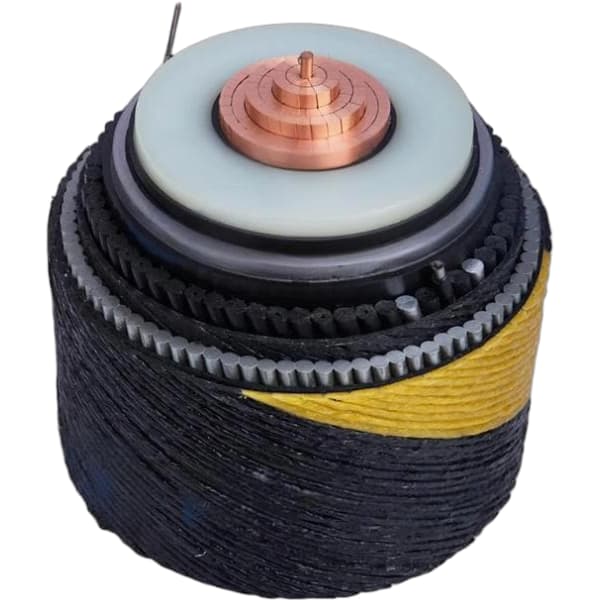
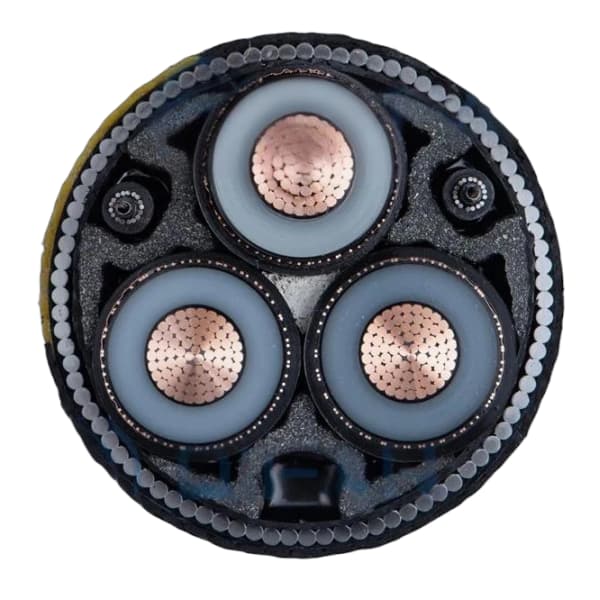
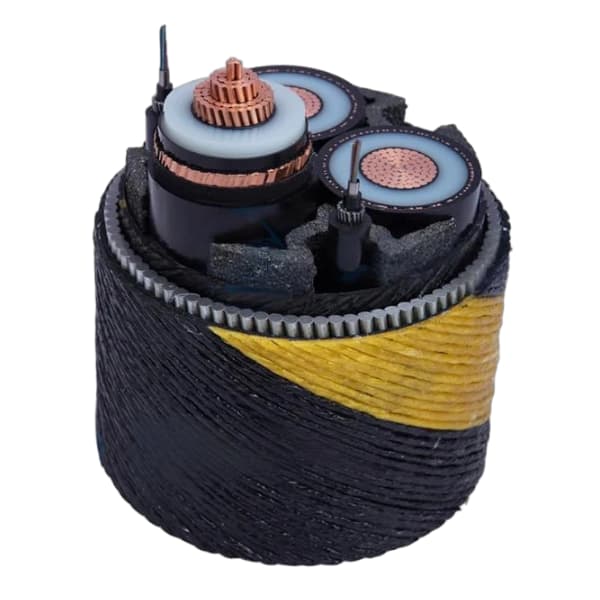
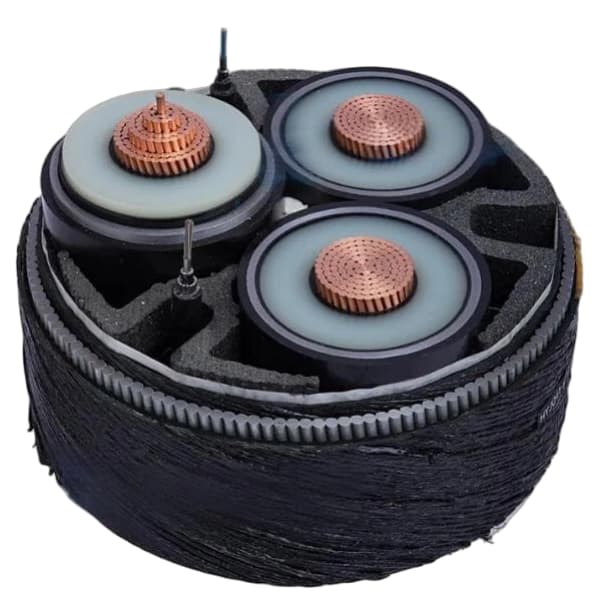
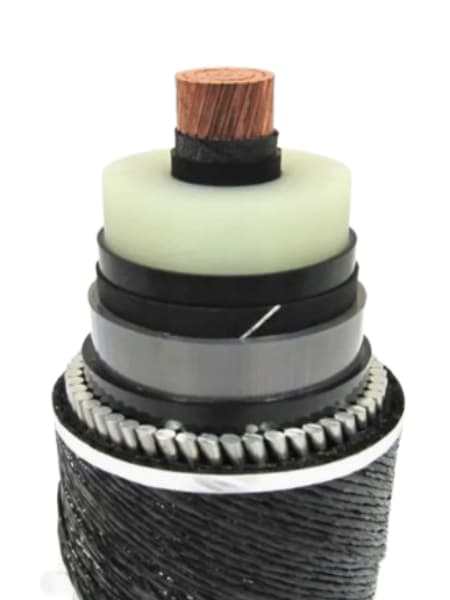
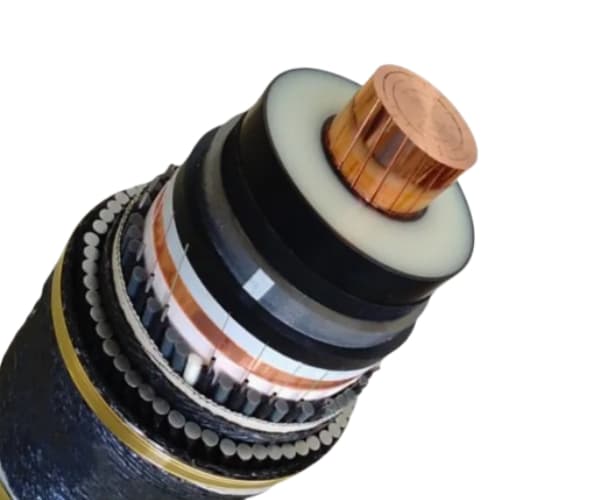
Manufacturers design a 230kV Submarine Cable with several layers. Each layer performs a specific electrical or mechanical function. 첫 번째, the conductor carries electrical current. 다음, insulation protects the conductor from electrical leakage. 마지막으로, armoring protects the cable from mechanical damage.
지휘자
The conductor forms the electrical core of the cable. Manufacturers usually produce conductors from copper or aluminum.
Copper conductors provide higher conductivity and stronger mechanical performance. 그 동안에, aluminum conductors reduce weight and project cost. 그러므로, engineers select conductor material according to transmission requirements.
Conductor Screen
Manufacturers apply a semiconductive conductor screen around the conductor. This layer smooths the electric field distribution. 따라서, the cable insulation operates more reliably.
Insulation Layer
The insulation layer prevents electrical leakage. Today, most 230kV Submarine Cable systems 사용 XLPE 단열재.
XLPE insulation provides several important advantages. 예를 들어, it offers high dielectric strength and excellent thermal performance. 게다가, it maintains stable electrical properties over long service periods.
Insulation Screen
Manufacturers apply another semiconductive layer over the insulation. 비슷하게, this layer helps maintain uniform electric field distribution.
Metallic Sheath
The metallic sheath protects the cable from water penetration. 게다가, it provides a grounding path for fault currents.
Manufacturers commonly use:
- 납 외장
- Aluminum sheath
- Copper sheath
Each material offers different corrosion resistance and mechanical properties.
Bedding Layer
The bedding layer separates the metallic sheath from the armoring layer. 게다가, it absorbs mechanical stress during cable installation.
장갑
Submarine cables require strong mechanical protection. 그러므로, manufacturers add steel wire armoring around the cable.
Armoring provides three major benefits:
- 기계적 보호
- Tensile strength during installation
- Resistance to fishing gear and anchors
Depending on the seabed conditions, engineers select single-layer or double-layer armoring.
외부 칼집
마지막으로, manufacturers apply an outer protective sheath. This layer protects the cable from seawater corrosion and abrasion. Most submarine cables use 폴리에틸렌 (체육) for this purpose.
Technical Specifications of 230kV Submarine Cable
Engineers design each 230kV Submarine Cable according to specific project requirements. 하지만, most cables share several common technical characteristics.
| Parameter | Typical Value |
|---|---|
| Rated Voltage | 230 케이 V |
| Frequency | 50 / 60 Hz |
| 절연 유형 | XLPE |
| Conductor Material | 구리 / 알류미늄 |
| Maximum Operating Temperature | 90℃ |
| Short Circuit Temperature | 250℃ |
| Installation Depth | 최대 1000 중 |
| Design Lifetime | 30-40년 |
These parameters ensure safe and reliable operation in marine environments.
Conductor Size Table for 230kV Submarine Cable (50–2500 mm²)
The conductor cross-section strongly influences the transmission capacity of the 230kV Submarine Cable. 일반적으로, larger conductors carry higher currents. 그 동안에, they also reduce electrical losses.
하지만, larger conductors increase cable weight and cost. 그러므로, engineers must balance performance and project budget.
| 지휘자 크기 (mm²) | 지름 (mm) | DC 저항 (아/km) | 현재 용량 (ㅏ) | 무게 (kg/km) |
|---|---|---|---|---|
| 50 | 8.0 | 0.387 | 180 | 450 |
| 70 | 9.5 | 0.268 | 220 | 520 |
| 95 | 11 | 0.193 | 260 | 610 |
| 120 | 12.5 | 0.153 | 300 | 720 |
| 150 | 13.8 | 0.124 | 340 | 830 |
| 185 | 15.5 | 0.099 | 380 | 980 |
| 240 | 17.5 | 0.075 | 430 | 1150 |
| 300 | 19.5 | 0.060 | 480 | 1320 |
| 400 | 22.5 | 0.047 | 560 | 1650 |
| 500 | 25.2 | 0.036 | 630 | 1950 |
| 630 | 28.5 | 0.028 | 700 | 2300 |
| 800 | 32 | 0.022 | 780 | 2700 |
| 1000 | 36 | 0.018 | 870 | 3200 |
| 1200 | 39.5 | 0.015 | 940 | 3600 |
| 1400 | 42.5 | 0.013 | 1000 | 4100 |
| 1600 | 45 | 0.011 | 1060 | 4600 |
| 1800 | 48 | 0.010 | 1120 | 5100 |
| 2000 | 51 | 0.009 | 1180 | 5600 |
| 2200 | 54 | 0.008 | 1240 | 6100 |
| 2500 | 58 | 0.007 | 1320 | 6900 |
따라서, engineers choose conductor size according to project capacity and installation conditions.
Installation of 230kV Submarine Cable
Installing a 230kV Submarine Cable requires specialized engineering equipment. 첫 번째, engineers conduct a detailed seabed survey. 다음, they plan the safest cable route.
After route planning, installation vessels lay the cable along the seabed. 그 동안에, engineers carefully monitor cable tension and bending radius.
마지막으로, burial equipment places the cable beneath the seabed. 일반적으로, engineers bury the cable 1–3 meters deep. 결과적으로, the cable receives protection from anchors and fishing equipment.
Applications of 230kV Submarine Cable
그만큼 230kV Submarine Cable supports several important energy projects.
해상 풍력 발전소
Offshore wind turbines generate electricity far from shore. 그러므로, developers install submarine cables to transmit electricity to mainland grids.
Island Power Supply
Many islands lack large power plants. 따라서, governments connect islands to mainland power systems using submarine cables.
International Grid Interconnection
Countries often connect their power grids across seas. 결과적으로, submarine cables improve energy security and grid stability.
Offshore Oil and Gas Platforms
Oil and gas companies also use submarine cables. These cables supply electricity to offshore drilling platforms and reduce diesel generator use.
Advantages of 230kV Submarine Cable
그만큼 230kV Submarine Cable offers several advantages.
첫 번째, it enables reliable power transmission across water. 두번째, it supports renewable energy projects such as offshore wind farms. 게다가, submarine cables reduce environmental impact compared with overhead lines.
게다가, these cables provide long service life and high transmission capacity. 그러므로, many countries continue to invest in submarine cable infrastructure.
230kV Submarine Cable
그만큼 230kV Submarine Cable has become an essential component of modern power transmission networks. It allows electricity to travel safely across oceans, 강하, and offshore energy installations.
게다가, the rapid expansion of offshore wind power and international grid connections continues to increase demand for submarine cables. 따라서, manufacturers continue to improve cable design, insulation technology, and mechanical protection.
With conductor sizes ranging from 50 mm² ~ 2500 mm², modern 230kV Submarine Cable systems provide flexible and reliable solutions for high-capacity power transmission.