
Em engenharia elétrica, escolher o tamanho correto do condutor é essencial. No entanto, regiões diferentes usam sistemas de medição diferentes. Sobre AWG em mm², Na América do Norte, profissionais usam AWG (Medidor de fio americano). Em contraste, a maioria dos mercados internacionais depende milímetros quadrados (mm²).
Como resultado, engenheiros, eletricistas, e os compradores geralmente precisam de uma forma confiável de conversão entre esses dois sistemas. Portanto, compreender a conversão de AWG para mm² torna-se fundamental para a seleção precisa do cabo.
Aqui, Dois cabos mostrará como funciona o sistema AWG, por que a conversão é importante, e como usar uma tabela de referência completa de forma eficaz.
O que significa AWG?
AWG significa American Wire Gauge. Define o diâmetro dos condutores elétricos usando um sistema numérico padronizado.
Ao contrário das medidas métricas, AWG segue uma escala reversa. Em outras palavras:
- Números menores indicam fios mais grossos
- Números maiores indicam fios mais finos
Por exemplo, 4/0 AWG tem um diâmetro muito maior do que 1 AWG. De forma similar, 12 AWG é mais espesso que 20 AWG.
Devido a esta estrutura única, muitos usuários acham o AWG confuso no início. No entanto, depois de entender o padrão, fica mais fácil comparar tamanhos de fios.
Por que você precisa de conversão de AWG para mm²
Em projetos globais, você não pode confiar em um único padrão. Em vez de, você deve alternar entre AWG e mm² dependendo da região. Por esta razão, a conversão desempenha um papel fundamental em diversas áreas.
1. Projetos Internacionais
Primeiro, diferentes países seguem padrões diferentes. Enquanto os EUA. usa AWG, a maioria das outras regiões usa mm². Portanto, a conversão garante que as especificações correspondam aos mercados.
2. Comparação de capacidade atual
Próximo, a área do condutor afeta diretamente a capacidade de transporte de corrente. Quando você converte AWG em mm², você pode comparar facilmente a ampacidade usando os padrões IEC.
3. Projeto Elétrico
Além disso, a maioria dos cálculos de engenharia requer unidades métricas. Como resultado, os projetistas devem converter os valores AWG em mm² antes de realizar os cálculos.
4. Aquisição e Fornecimento
Finalmente, os compradores costumam comparar produtos de fornecedores diferentes. Usando uma tabela de conversão, eles podem identificar rapidamente tamanhos de cabos equivalentes.
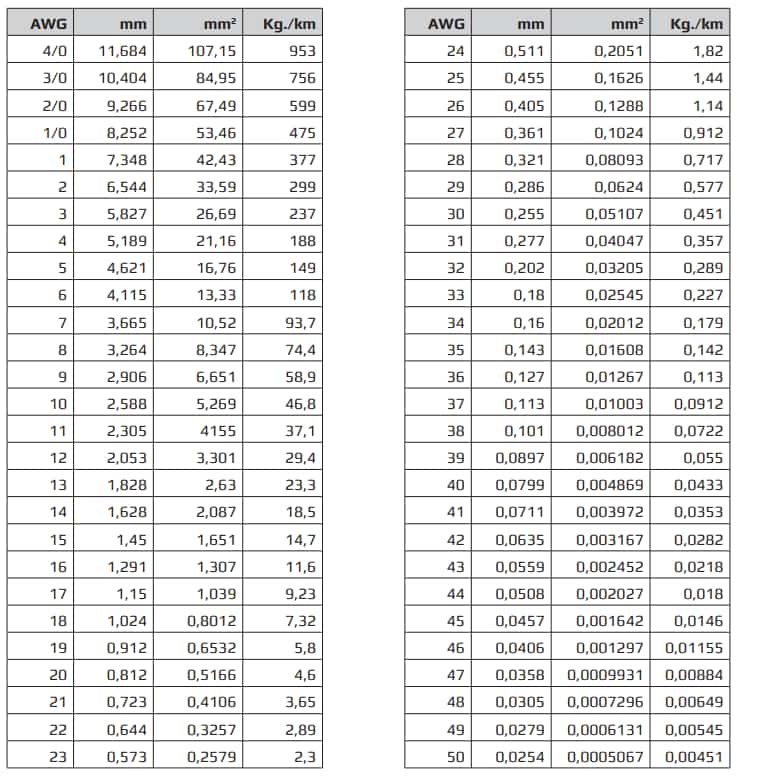
Tabela de conversão de AWG para mm²
Abaixo está uma tabela de referência prática mostrando o diâmetro do condutor, área transversal, e peso aproximado de cobre:
| AWG | Diâmetro (milímetros) | Área (mm²) | Peso (kg/km) |
|---|---|---|---|
| 4/0 | 11.684 | 107.15 | 953 |
| 3/0 | 10.404 | 84.95 | 756 |
| 2/0 | 9.266 | 67.49 | 599 |
| 1/0 | 8.252 | 53.46 | 475 |
| 1 | 7.348 | 42.43 | 377 |
| 2 | 6.544 | 33.59 | 299 |
| 3 | 5.827 | 26.69 | 237 |
| 4 | 5.189 | 21.16 | 188 |
| 5 | 4.621 | 16.76 | 149 |
| 6 | 4.115 | 13.33 | 118 |
| 7 | 3.665 | 10.52 | 93.7 |
| 8 | 3.264 | 8.347 | 74.4 |
| 9 | 2.906 | 6.651 | 58.9 |
| 10 | 2.588 | 5.269 | 46.8 |
| 11 | 2.305 | 4.155 | 37.1 |
| 12 | 2.053 | 3.301 | 29.4 |
| 13 | 1.828 | 2.63 | 23.3 |
| 14 | 1.628 | 2.087 | 18.5 |
| 15 | 1.45 | 1.651 | 14.7 |
| 16 | 1.291 | 1.307 | 11.6 |
| 17 | 1.15 | 1.039 | 9.23 |
| 18 | 1.024 | 0.8012 | 7.32 |
| 19 | 0.912 | 0.6532 | 5.8 |
| 20 | 0.812 | 0.5166 | 4.6 |
| 21 | 0.723 | 0.4106 | 3.65 |
| 22 | 0.644 | 0.3257 | 2.89 |
| 23 | 0.573 | 0.2579 | 2.3 |
| 24 | 0.511 | 0.2051 | 1.82 |
| 25 | 0.455 | 0.1626 | 1.44 |
| 26 | 0.405 | 0.1288 | 1.14 |
| 27 | 0.361 | 0.1024 | 0.912 |
| 28 | 0.321 | 0.08093 | 0.717 |
| 29 | 0.286 | 0.0624 | 0.577 |
| 30 | 0.255 | 0.05107 | 0.451 |
| 31 | 0.227 | 0.04047 | 0.357 |
| 32 | 0.202 | 0.03205 | 0.289 |
| 33 | 0.180 | 0.02545 | 0.227 |
| 34 | 0.160 | 0.02012 | 0.179 |
| 35 | 0.143 | 0.01608 | 0.142 |
| 36 | 0.127 | 0.01267 | 0.113 |
Equivalentes de tamanho de fio comum
Para simplificar a seleção, você pode se lembrar de algumas conversões importantes. Por exemplo:
- 12 AWG é igual a aproximadamente 3.31 mm²
- 10 AWG é igual a cerca de 5.26 mm²
- 8 AWG corresponde a aproximadamente 8.37 mm²
- 6 AWG converte para 13.3 mm²
Esses tamanhos aparecem frequentemente em aplicações reais. Por exemplo, eles são amplamente utilizados na fiação de edifícios, sistemas solares, e instalações industriais.
Como funciona a conversão
Você pode calcular a área do condutor usando uma fórmula básica:UMA=4π×d2
Aqui, d representa o diâmetro do condutor em milímetros.
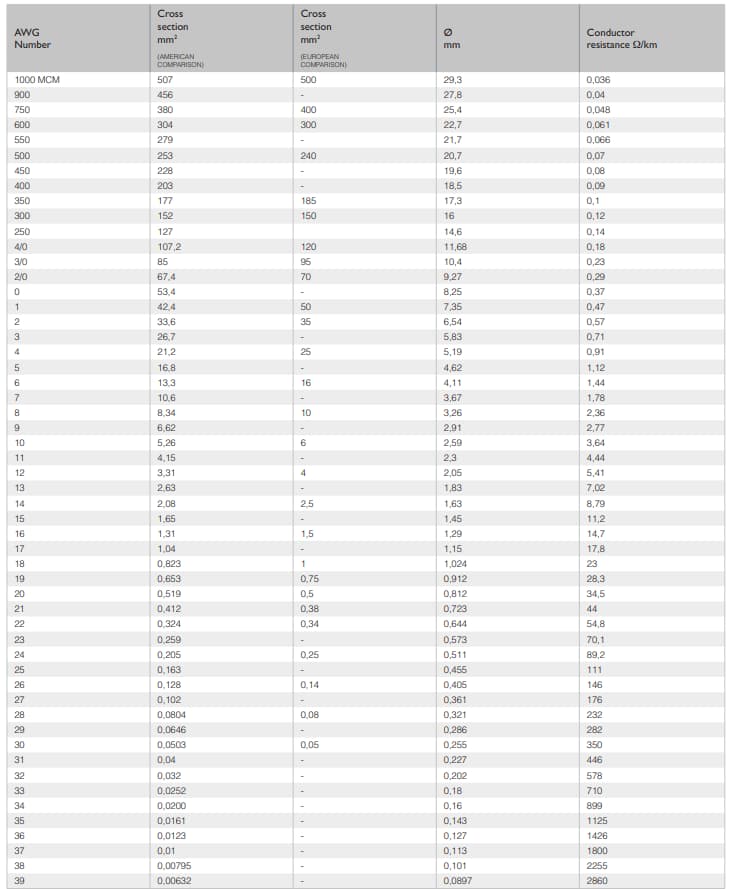
No entanto, AWG segue uma progressão logarítmica. Portanto, cálculo manual nem sempre é prático. Em vez de, a maioria dos profissionais confia em tabelas padrão para resultados mais rápidos e precisos.
AWG e mm²: Principais diferenças
Embora ambos os sistemas meçam o tamanho do condutor, eles atendem diferentes regiões. Por um lado, AWG domina na América do Norte. Por outro lado, mm² continua sendo o padrão global.
Devido a esta, projetos internacionais geralmente exigem ambos os sistemas. Consequentemente, compreender seu relacionamento ajuda a evitar erros de especificação.
Conclusão
O dimensionamento preciso dos fios afeta diretamente a segurança e o desempenho. Portanto, dominar a conversão de AWG para mm² é essencial para engenheiros, fabricantes, e compradores.
Usando uma tabela de conversão confiável, você pode:
- Selecione o tamanho correto do cabo
- Compare padrões globais de forma eficiente
- Garanta a capacidade atual adequada
- Melhore as decisões de compra
No fim, um gráfico de conversão simples pode economizar tempo, reduzir erros, e melhorar os resultados do projeto.