
În inginerie electrică, alegerea dimensiunii corecte a conductorului este esențială. in orice caz, regiuni diferite folosesc sisteme de măsurare diferite. Aproximativ AWG la mm², În America de Nord, folosesc profesionistii AWG (American Wire Gauge). În contrast, pe care se bazează majoritatea piețelor internaționale milimetri pătrați (mm²).
Ca urmare, ingineri, electricieni, iar cumpărătorii au adesea nevoie de o modalitate fiabilă de conversie între aceste două sisteme. Prin urmare, înțelegerea conversiei AWG în mm² devine critică pentru o selecție precisă a cablurilor.
Aici, DOUA Cablu va arăta cum funcționează sistemul AWG, de ce contează conversia, și cum să utilizați eficient un tabel de referință complet.
Ce înseamnă AWG?
AWG înseamnă American Wire Gauge. Acesta definește diametrul conductorilor electrici folosind un sistem numeric standardizat.
Spre deosebire de măsurătorile metrice, AWG urmează o scară inversă. Cu alte cuvinte:
- Numerele mai mici indică fire mai groase
- Numerele mai mari indică fire mai subțiri
De exemplu, 4/0 AWG are un diametru mult mai mare decât 1 AWG. În mod similar, 12 AWG este mai gros decât 20 AWG.
Datorită acestei structuri unice, mulți utilizatori consideră AWG confuz la început. in orice caz, odată ce înțelegi tiparul, devine mai ușor să comparați dimensiunile firelor.
De ce aveți nevoie de conversia AWG în mm²
În proiecte globale, nu te poți baza pe un singur standard. În schimb, trebuie să comutați între AWG și mm² în funcție de regiune. Din acest motiv, conversia joacă un rol cheie în mai multe domenii.
1. Proiecte internaționale
Primul, diferite țări urmează standarde diferite. În timp ce S.U.A. folosește AWG, majoritatea celorlalte regiuni folosesc mm². Prin urmare, conversia asigură că specificațiile se potrivesc între piețe.
2. Comparația capacității curente
Următorul, zona conductorului afectează direct capacitatea de purtare a curentului. Când convertiți AWG în mm², puteți compara cu ușurință intensitatea utilizând standardele IEC.
3. Proiectare electrică
în plus, majoritatea calculelor de inginerie necesită unități metrice. Ca urmare, proiectanții trebuie să convertească valorile AWG în mm² înainte de a efectua calcule.
4. Achiziții și aprovizionare
In sfarsit, cumpărătorii compară adesea produse de la diferiți furnizori. Prin utilizarea unui tabel de conversie, pot identifica rapid dimensiunile echivalente ale cablurilor.
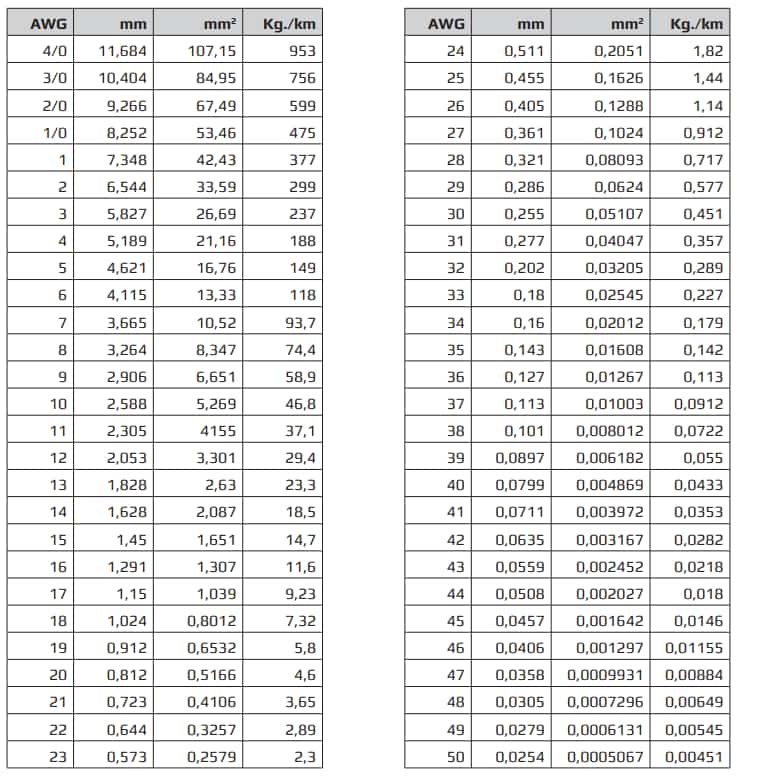
Tabel de conversie AWG în mm²
Mai jos este un tabel practic de referință care arată diametrul conductorului, zona secțiunii transversale, și greutatea aproximativă a cuprului:
| AWG | Diametru (mm) | Zonă (mm²) | Greutate (kg/km) |
|---|---|---|---|
| 4/0 | 11.684 | 107.15 | 953 |
| 3/0 | 10.404 | 84.95 | 756 |
| 2/0 | 9.266 | 67.49 | 599 |
| 1/0 | 8.252 | 53.46 | 475 |
| 1 | 7.348 | 42.43 | 377 |
| 2 | 6.544 | 33.59 | 299 |
| 3 | 5.827 | 26.69 | 237 |
| 4 | 5.189 | 21.16 | 188 |
| 5 | 4.621 | 16.76 | 149 |
| 6 | 4.115 | 13.33 | 118 |
| 7 | 3.665 | 10.52 | 93.7 |
| 8 | 3.264 | 8.347 | 74.4 |
| 9 | 2.906 | 6.651 | 58.9 |
| 10 | 2.588 | 5.269 | 46.8 |
| 11 | 2.305 | 4.155 | 37.1 |
| 12 | 2.053 | 3.301 | 29.4 |
| 13 | 1.828 | 2.63 | 23.3 |
| 14 | 1.628 | 2.087 | 18.5 |
| 15 | 1.45 | 1.651 | 14.7 |
| 16 | 1.291 | 1.307 | 11.6 |
| 17 | 1.15 | 1.039 | 9.23 |
| 18 | 1.024 | 0.8012 | 7.32 |
| 19 | 0.912 | 0.6532 | 5.8 |
| 20 | 0.812 | 0.5166 | 4.6 |
| 21 | 0.723 | 0.4106 | 3.65 |
| 22 | 0.644 | 0.3257 | 2.89 |
| 23 | 0.573 | 0.2579 | 2.3 |
| 24 | 0.511 | 0.2051 | 1.82 |
| 25 | 0.455 | 0.1626 | 1.44 |
| 26 | 0.405 | 0.1288 | 1.14 |
| 27 | 0.361 | 0.1024 | 0.912 |
| 28 | 0.321 | 0.08093 | 0.717 |
| 29 | 0.286 | 0.0624 | 0.577 |
| 30 | 0.255 | 0.05107 | 0.451 |
| 31 | 0.227 | 0.04047 | 0.357 |
| 32 | 0.202 | 0.03205 | 0.289 |
| 33 | 0.180 | 0.02545 | 0.227 |
| 34 | 0.160 | 0.02012 | 0.179 |
| 35 | 0.143 | 0.01608 | 0.142 |
| 36 | 0.127 | 0.01267 | 0.113 |
Echivalente comune de dimensiune a firului
Pentru a simplifica selecția, vă puteți aminti câteva conversii cheie. De exemplu:
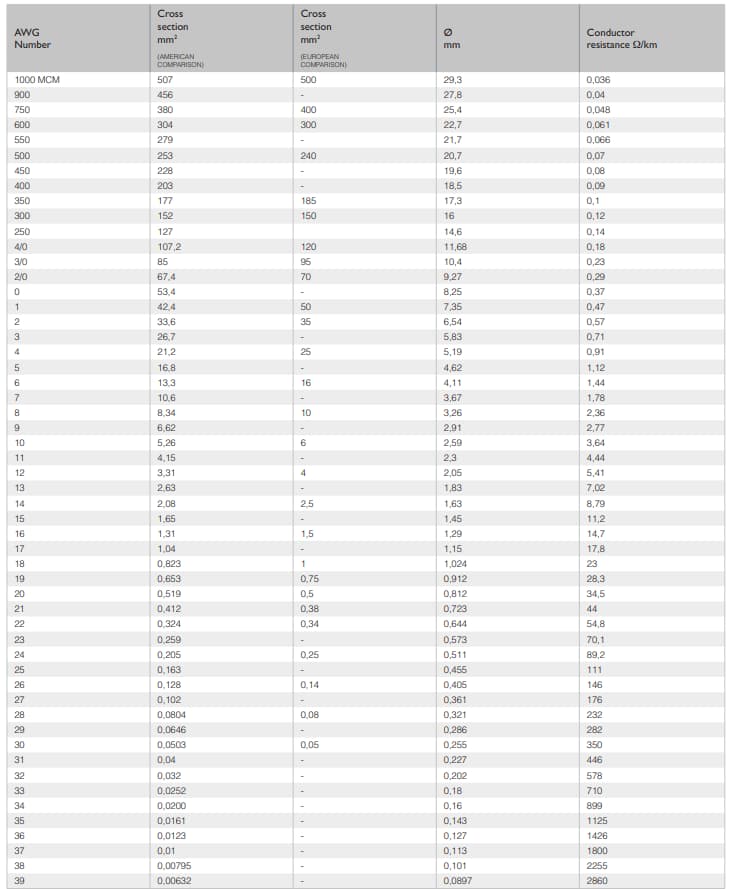
- 12 AWG este aproximativ 3.31 mm²
- 10 AWG este egal cu aproximativ 5.26 mm²
- 8 AWG corespunde aproximativ 8.37 mm²
- 6 AWG se convertește în 13.3 mm²
Aceste dimensiuni apar frecvent în aplicațiile reale. De exemplu, sunt utilizate pe scară largă în cablarea clădirilor, sisteme solare, si instalatii industriale.
Cum funcționează conversia
Puteți calcula aria conductorului folosind o formulă de bază:A=4π×d2
Aici, d reprezintă diametrul conductorului în milimetri.
in orice caz, AWG urmează o progresie logaritmică. Prin urmare, calculul manual nu este întotdeauna practic. În schimb, majoritatea profesioniștilor se bazează pe tabele standard pentru rezultate mai rapide și mai precise.
AWG și mm²: Diferențele cheie
Deși ambele sisteme măsoară dimensiunea conductorului, deservesc regiuni diferite. Pe de o parte, AWG domină în America de Nord. Pe de altă parte, mm² rămâne standardul global.
Din acest motiv, proiectele internaționale necesită adesea ambele sisteme. în consecinţă, înțelegerea relației lor ajută la prevenirea erorilor de specificație.
Concluzie
Dimensionarea precisă a firelor afectează direct siguranța și performanța. Prin urmare, stăpânirea conversiei AWG în mm² este esențială pentru ingineri, producatori, și cumpărători.
Prin utilizarea unui tabel de conversie de încredere, puteți:
- Selectați dimensiunea corectă a cablului
- Comparați eficient standardele globale
- Asigurați-vă capacitatea de curent adecvată
- Îmbunătățiți deciziile de cumpărare
În cele din urmă, o simplă diagramă de conversie poate economisi timp, reduce erorile, și îmbunătățirea rezultatelor proiectului.