
Di bidang teknik elektro, memilih ukuran konduktor yang benar sangatlah penting. Namun, daerah yang berbeda menggunakan sistem pengukuran yang berbeda. Tentang AWG ke mm², Di Amerika Utara, penggunaan profesional AWG (Pengukur Kawat Amerika). Sebaliknya, yang diandalkan oleh sebagian besar pasar internasional milimeter persegi (mm²).
Sebagai akibat, insinyur, tukang listrik, dan pembeli sering kali membutuhkan cara yang andal untuk mengkonversi kedua sistem ini. Karena itu, memahami konversi AWG ke mm² menjadi penting untuk pemilihan kabel yang akurat.
Di Sini, DUA Kabel akan menunjukkan cara kerja sistem AWG, mengapa konversi itu penting, dan cara menggunakan tabel referensi lengkap secara efektif.
Apa Arti AWG?
AWG adalah singkatan dari American Wire Gauge. Ini mendefinisikan diameter konduktor listrik menggunakan sistem numerik standar.
Berbeda dengan pengukuran metrik, AWG mengikuti skala terbalik. Dengan kata lain:
- Angka yang lebih kecil menunjukkan kabel yang lebih tebal
- Angka yang lebih besar menunjukkan kabel yang lebih tipis
Misalnya, 4/0 AWG memiliki diameter yang jauh lebih besar dibandingkan 1 AWG. Demikian pula, 12 AWG lebih tebal dari 20 AWG.
Karena strukturnya yang unik ini, banyak pengguna menganggap AWG membingungkan pada awalnya. Namun, setelah Anda memahami polanya, menjadi lebih mudah untuk membandingkan ukuran kawat.
Mengapa Anda Membutuhkan Konversi AWG ke mm²
Dalam proyek global, Anda tidak dapat mengandalkan satu standar saja. Alih-alih, Anda harus beralih antara AWG dan mm² tergantung wilayahnya. Untuk alasan ini, konversi memainkan peran penting dalam beberapa bidang.
1. Proyek Internasional
Pertama, negara yang berbeda mengikuti standar yang berbeda. Sementara AS. menggunakan AWG, sebagian besar wilayah lain menggunakan mm². Karena itu, konversi memastikan bahwa spesifikasi cocok di seluruh pasar.
2. Perbandingan Kapasitas Saat Ini
Berikutnya, luas konduktor secara langsung mempengaruhi daya hantar arus. Saat Anda mengonversi AWG ke mm², Anda dapat dengan mudah membandingkan ampacity menggunakan standar IEC.
3. Desain Listrik
Selain itu, sebagian besar perhitungan teknik memerlukan satuan metrik. Sebagai akibat, desainer harus mengubah nilai AWG menjadi mm² sebelum melakukan perhitungan.
4. Pengadaan dan Pengadaan
Akhirnya, pembeli sering membandingkan produk dari pemasok yang berbeda. Dengan menggunakan tabel konversi, mereka dapat dengan cepat mengidentifikasi ukuran kabel yang setara.
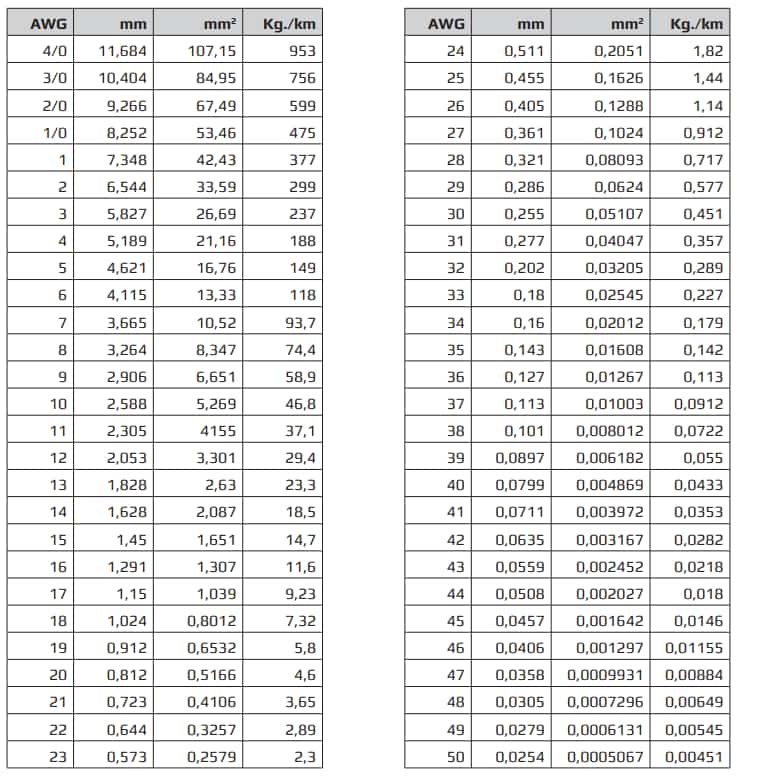
Tabel Konversi AWG ke mm²
Di bawah ini adalah tabel referensi praktis yang menunjukkan diameter konduktor, luas penampang, dan perkiraan berat tembaga:
| AWG | Diameter (mm) | Daerah (mm²) | Berat (kg/km) |
|---|---|---|---|
| 4/0 | 11.684 | 107.15 | 953 |
| 3/0 | 10.404 | 84.95 | 756 |
| 2/0 | 9.266 | 67.49 | 599 |
| 1/0 | 8.252 | 53.46 | 475 |
| 1 | 7.348 | 42.43 | 377 |
| 2 | 6.544 | 33.59 | 299 |
| 3 | 5.827 | 26.69 | 237 |
| 4 | 5.189 | 21.16 | 188 |
| 5 | 4.621 | 16.76 | 149 |
| 6 | 4.115 | 13.33 | 118 |
| 7 | 3.665 | 10.52 | 93.7 |
| 8 | 3.264 | 8.347 | 74.4 |
| 9 | 2.906 | 6.651 | 58.9 |
| 10 | 2.588 | 5.269 | 46.8 |
| 11 | 2.305 | 4.155 | 37.1 |
| 12 | 2.053 | 3.301 | 29.4 |
| 13 | 1.828 | 2.63 | 23.3 |
| 14 | 1.628 | 2.087 | 18.5 |
| 15 | 1.45 | 1.651 | 14.7 |
| 16 | 1.291 | 1.307 | 11.6 |
| 17 | 1.15 | 1.039 | 9.23 |
| 18 | 1.024 | 0.8012 | 7.32 |
| 19 | 0.912 | 0.6532 | 5.8 |
| 20 | 0.812 | 0.5166 | 4.6 |
| 21 | 0.723 | 0.4106 | 3.65 |
| 22 | 0.644 | 0.3257 | 2.89 |
| 23 | 0.573 | 0.2579 | 2.3 |
| 24 | 0.511 | 0.2051 | 1.82 |
| 25 | 0.455 | 0.1626 | 1.44 |
| 26 | 0.405 | 0.1288 | 1.14 |
| 27 | 0.361 | 0.1024 | 0.912 |
| 28 | 0.321 | 0.08093 | 0.717 |
| 29 | 0.286 | 0.0624 | 0.577 |
| 30 | 0.255 | 0.05107 | 0.451 |
| 31 | 0.227 | 0.04047 | 0.357 |
| 32 | 0.202 | 0.03205 | 0.289 |
| 33 | 0.180 | 0.02545 | 0.227 |
| 34 | 0.160 | 0.02012 | 0.179 |
| 35 | 0.143 | 0.01608 | 0.142 |
| 36 | 0.127 | 0.01267 | 0.113 |
Setara Ukuran Kawat Biasa
Untuk menyederhanakan pemilihan, Anda dapat mengingat beberapa konversi penting. Misalnya:
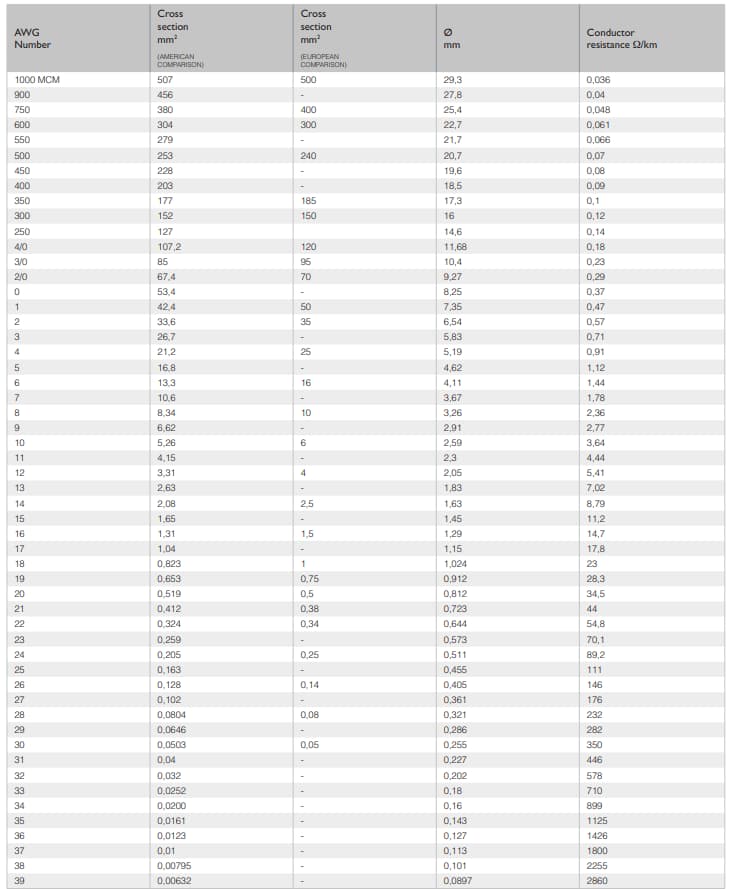
- 12 AWG kira-kira sama 3.31 mm²
- 10 AWG sama dengan sekitar 5.26 mm²
- 8 AWG sesuai dengan kira-kira 8.37 mm²
- 6 AWG mengkonversi menjadi 13.3 mm²
Ukuran ini sering muncul dalam aplikasi nyata. Misalnya, mereka banyak digunakan dalam membangun kabel, tata surya, dan instalasi industri.
Cara Kerja Konversi
Anda dapat menghitung luas konduktor menggunakan rumus dasar:SEBUAH=4π×d2
Di Sini, D mewakili diameter konduktor dalam milimeter.
Namun, AWG mengikuti perkembangan logaritmik. Karena itu, perhitungan manual tidak selalu praktis. Alih-alih, sebagian besar profesional mengandalkan tabel standar untuk hasil yang lebih cepat dan akurat.
AWG dan mm²: Perbedaan Utama
Meskipun kedua sistem mengukur ukuran konduktor, mereka melayani wilayah yang berbeda. Di satu sisi, AWG mendominasi di Amerika Utara. Di sisi lain, mm² tetap menjadi standar global.
Karena ini, proyek internasional sering kali memerlukan kedua sistem tersebut. Akibatnya, memahami hubungan mereka membantu mencegah kesalahan spesifikasi.
Kesimpulan
Ukuran kawat yang akurat secara langsung mempengaruhi keselamatan dan kinerja. Karena itu, menguasai konversi AWG ke mm² sangat penting bagi para insinyur, produsen, dan pembeli.
Dengan menggunakan tabel konversi yang andal, kamu bisa:
- Pilih ukuran kabel yang benar
- Bandingkan standar global secara efisien
- Pastikan kapasitas arus yang tepat
- Meningkatkan keputusan pembelian
Pada akhirnya, bagan konversi sederhana dapat menghemat waktu, mengurangi kesalahan, dan meningkatkan hasil proyek.