
Trong kỹ thuật điện, việc lựa chọn kích thước dây dẫn chính xác là điều cần thiết. Tuy nhiên, các khu vực khác nhau sử dụng các hệ thống đo lường khác nhau. Giới thiệu về AWG sang mm², Ở Bắc Mỹ, các chuyên gia sử dụng AWG (Máy đo dây của Mỹ). Ngược lại, hầu hết các thị trường quốc tế đều dựa vào milimét vuông (mm²).
Kết quả là, kỹ sư, thợ điện, và người mua thường cần một phương pháp đáng tin cậy để chuyển đổi giữa hai hệ thống này. Vì thế, hiểu rõ việc chuyển đổi AWG sang mm2 trở nên quan trọng để lựa chọn cáp chính xác.
Đây, HAI cáp sẽ cho thấy hệ thống AWG hoạt động như thế nào, tại sao chuyển đổi lại quan trọng, và cách sử dụng bảng tham chiếu đầy đủ một cách hiệu quả.
AWG có nghĩa là gì?
AWG là viết tắt của Máy đo dây Mỹ.. Nó xác định đường kính của dây dẫn điện bằng hệ thống số tiêu chuẩn.
Không giống như các phép đo hệ mét, AWG tuân theo quy mô ngược lại. Nói cách khác:
- Số nhỏ hơn cho thấy dây dày hơn
- Số lớn hơn cho thấy dây mỏng hơn
Ví dụ, 4/0 AWG có đường kính lớn hơn nhiều so với 1 AWG. Tương tự, 12 AWG dày hơn 20 AWG.
Vì cấu trúc độc đáo này, nhiều người dùng lúc đầu thấy AWG khó hiểu. Tuy nhiên, một khi bạn hiểu được mô hình, việc so sánh kích cỡ dây trở nên dễ dàng hơn.
Tại sao bạn cần chuyển đổi AWG sang mm²
Trong các dự án toàn cầu, bạn không thể dựa vào một tiêu chuẩn duy nhất. Thay vì, bạn phải chuyển đổi giữa AWG và mm² tùy theo khu vực. Vì lý do này, chuyển đổi đóng một vai trò quan trọng trong một số lĩnh vực.
1. Dự án quốc tế
Đầu tiên, các quốc gia khác nhau tuân theo các tiêu chuẩn khác nhau. Trong khi Mỹ. sử dụng AWG, hầu hết các khu vực khác đều sử dụng mm². Vì thế, chuyển đổi đảm bảo rằng các thông số kỹ thuật phù hợp trên các thị trường.
2. So sánh công suất hiện tại
Kế tiếp, diện tích dây dẫn ảnh hưởng trực tiếp đến khả năng mang dòng điện. Khi bạn chuyển đổi AWG sang mm², bạn có thể dễ dàng so sánh độ khuếch đại bằng các tiêu chuẩn IEC.
3. Thiết kế điện
Ngoài ra, hầu hết các tính toán kỹ thuật đều yêu cầu đơn vị số liệu. Kết quả là, nhà thiết kế phải chuyển đổi giá trị AWG thành mm² trước khi thực hiện tính toán.
4. Mua sắm và tìm nguồn cung ứng
Cuối cùng, người mua thường so sánh sản phẩm từ các nhà cung cấp khác nhau. Bằng cách sử dụng bảng chuyển đổi, họ có thể nhanh chóng xác định kích thước cáp tương đương.
Bảng chuyển đổi AWG sang mm²
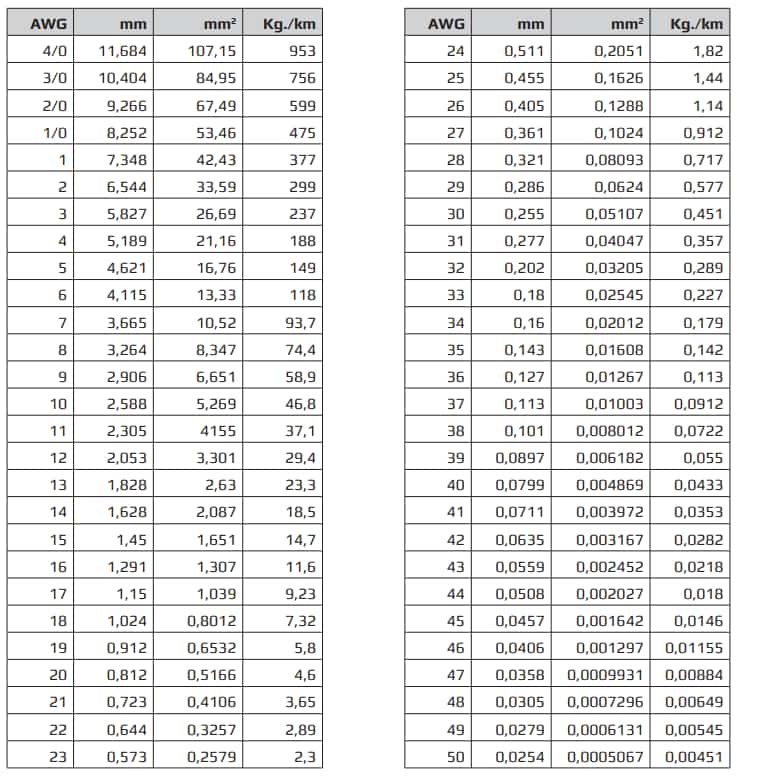
Dưới đây là bảng tham khảo thực tế cho thấy đường kính dây dẫn, diện tích mặt cắt ngang, và trọng lượng đồng gần đúng:
| AWG | Đường kính (mm) | Khu vực (mm²) | Cân nặng (kg/km) |
|---|---|---|---|
| 4/0 | 11.684 | 107.15 | 953 |
| 3/0 | 10.404 | 84.95 | 756 |
| 2/0 | 9.266 | 67.49 | 599 |
| 1/0 | 8.252 | 53.46 | 475 |
| 1 | 7.348 | 42.43 | 377 |
| 2 | 6.544 | 33.59 | 299 |
| 3 | 5.827 | 26.69 | 237 |
| 4 | 5.189 | 21.16 | 188 |
| 5 | 4.621 | 16.76 | 149 |
| 6 | 4.115 | 13.33 | 118 |
| 7 | 3.665 | 10.52 | 93.7 |
| 8 | 3.264 | 8.347 | 74.4 |
| 9 | 2.906 | 6.651 | 58.9 |
| 10 | 2.588 | 5.269 | 46.8 |
| 11 | 2.305 | 4.155 | 37.1 |
| 12 | 2.053 | 3.301 | 29.4 |
| 13 | 1.828 | 2.63 | 23.3 |
| 14 | 1.628 | 2.087 | 18.5 |
| 15 | 1.45 | 1.651 | 14.7 |
| 16 | 1.291 | 1.307 | 11.6 |
| 17 | 1.15 | 1.039 | 9.23 |
| 18 | 1.024 | 0.8012 | 7.32 |
| 19 | 0.912 | 0.6532 | 5.8 |
| 20 | 0.812 | 0.5166 | 4.6 |
| 21 | 0.723 | 0.4106 | 3.65 |
| 22 | 0.644 | 0.3257 | 2.89 |
| 23 | 0.573 | 0.2579 | 2.3 |
| 24 | 0.511 | 0.2051 | 1.82 |
| 25 | 0.455 | 0.1626 | 1.44 |
| 26 | 0.405 | 0.1288 | 1.14 |
| 27 | 0.361 | 0.1024 | 0.912 |
| 28 | 0.321 | 0.08093 | 0.717 |
| 29 | 0.286 | 0.0624 | 0.577 |
| 30 | 0.255 | 0.05107 | 0.451 |
| 31 | 0.227 | 0.04047 | 0.357 |
| 32 | 0.202 | 0.03205 | 0.289 |
| 33 | 0.180 | 0.02545 | 0.227 |
| 34 | 0.160 | 0.02012 | 0.179 |
| 35 | 0.143 | 0.01608 | 0.142 |
| 36 | 0.127 | 0.01267 | 0.113 |
Kích thước dây tương đương phổ biến
Để đơn giản hóa việc lựa chọn, bạn có thể nhớ một số chuyển đổi quan trọng. Ví dụ:
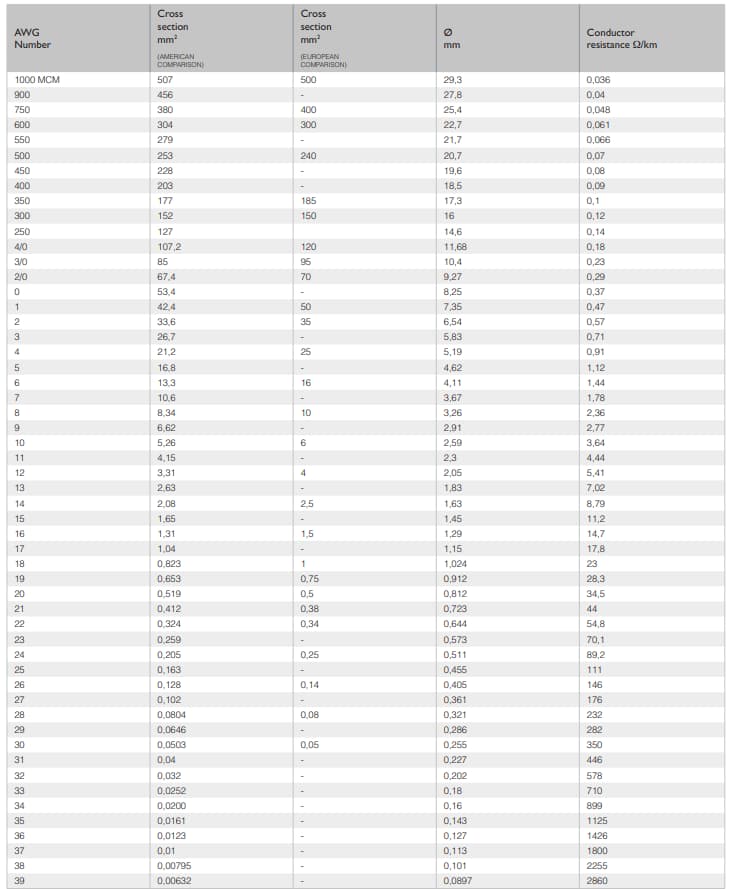
- 12 AWG bằng khoảng 3.31 mm²
- 10 AWG bằng khoảng 5.26 mm²
- 8 AWG tương ứng với khoảng 8.37 mm²
- 6 AWG chuyển đổi thành 13.3 mm²
Những kích thước này xuất hiện thường xuyên trong các ứng dụng thực tế. Ví dụ, chúng được sử dụng rộng rãi trong việc xây dựng hệ thống dây điện, hệ mặt trời, và các công trình công nghiệp.
Cách chuyển đổi hoạt động
Bạn có thể tính diện tích dây dẫn bằng công thức cơ bản:A=4π×d2
Đây, d đại diện cho đường kính dây dẫn tính bằng milimét.
Tuy nhiên, AWG tuân theo tiến trình logarit. Vì thế, tính toán thủ công không phải lúc nào cũng thực tế. Thay vì, hầu hết các chuyên gia đều dựa vào bảng tiêu chuẩn để có kết quả nhanh hơn và chính xác hơn.
AWG và mm2: Sự khác biệt chính
Mặc dù cả hai hệ thống đều đo kích thước dây dẫn, họ phục vụ các khu vực khác nhau. Một mặt, AWG thống trị ở Bắc Mỹ. Mặt khác, mm² vẫn là tiêu chuẩn toàn cầu.
Vì điều này, các dự án quốc tế thường yêu cầu cả hai hệ thống. Do đó, hiểu mối quan hệ của họ giúp ngăn ngừa lỗi đặc tả.
Phần kết luận
Kích thước dây chính xác ảnh hưởng trực tiếp đến an toàn và hiệu suất. Vì thế, nắm vững việc chuyển đổi AWG sang mm² là điều cần thiết đối với các kỹ sư, nhà sản xuất, và người mua.
Bằng cách sử dụng bảng chuyển đổi đáng tin cậy, bạn có thể:
- Chọn đúng kích cỡ cáp
- So sánh các tiêu chuẩn toàn cầu một cách hiệu quả
- Đảm bảo công suất hiện tại phù hợp
- Cải thiện quyết định mua hàng
Cuối cùng, một biểu đồ chuyển đổi đơn giản có thể tiết kiệm thời gian, giảm sai sót, và cải thiện kết quả dự án.